
SAP Business One Cloud vs On-Premise: Which Should You Choose?
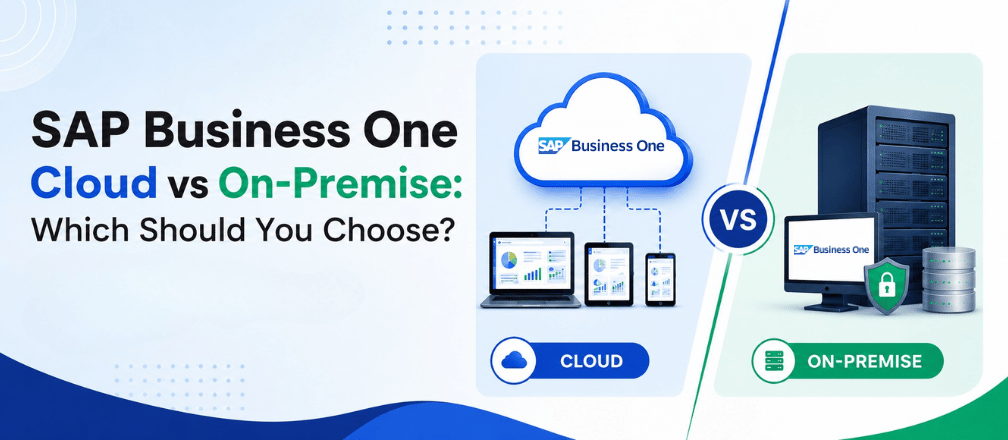
Choosing the right ERP deployment model is an important decision for any growing business. With SAP Business One, companies can choose a deployment approach that aligns with their IT infrastructure, budget, security requirements, accessibility needs and long-term growth plans.
Two common options are SAP Business One Cloud and SAP Business One On-Premise.
While Cloud deployment offers flexibility, remote accessibility and reduced infrastructure management, On-Premise deployment provides greater control over the underlying IT environment and infrastructure.
But which option is right for your business?
In this guide, we compare SAP Business One Cloud vs On-Premise based on cost, security, scalability, accessibility, maintenance, customization and suitability for manufacturing businesses.
What Is SAP Business One Cloud?
SAP Business One Cloud allows businesses to run their ERP solution in a cloud-based hosting environment instead of maintaining the complete server infrastructure at their own premises.
With a Cloud deployment, businesses can access SAP Business One from different locations, subject to the configured infrastructure and connectivity. The underlying hosting infrastructure is managed as part of the cloud arrangement, reducing the need for businesses to maintain physical ERP servers themselves.
This can be particularly useful for growing companies with multiple offices, warehouses, plants or employees who need access to business information from different locations.
Key benefits can include:
-
- Remote access to business applications
- Reduced requirement for in-house server infrastructure
- Easier infrastructure scalability
- Reduced infrastructure management responsibilities
- Support for multi-location operations
- Access to ERP data from different locations
- Potentially lower upfront infrastructure investment
For companies looking to focus their internal IT resources on business applications rather than server infrastructure, a Cloud deployment can be an attractive option.
What Is SAP Business One On-Premise?
With an On-Premise deployment, SAP Business One is installed and operated within the company’s own IT infrastructure or a dedicated infrastructure environment managed by the organization.
The business has greater control over its infrastructure, servers, network environment and related IT policies. However, this also means the organization may be responsible for infrastructure management, maintenance, backups, security and hardware upgrades, depending on its setup and support arrangement.
On-Premise can be suitable for organizations that already have established IT infrastructure and internal technical resources or have specific infrastructure requirements.
Key benefits can include:
-
- Greater control over the IT environment
- Control over infrastructure and network configuration
- Ability to leverage existing infrastructure
- Greater control over internal data management policies
- Suitable for businesses with dedicated IT teams
- Potential flexibility for specific infrastructure requirements
SAP Business One Cloud vs On-Premise: Key Differences
The biggest difference between the two deployment models is where and how the ERP infrastructure is hosted and managed.
|
Factor |
SAP Business One Cloud |
SAP Business One On-Premise |
|
Infrastructure |
Hosted in a cloud environment |
Hosted within the organization’s infrastructure |
|
Hardware |
Limited requirement for in-house ERP servers |
Requires suitable server infrastructure |
|
Accessibility |
Convenient remote accessibility |
Depends on network and remote-access configuration |
|
Infrastructure Management |
Reduced infrastructure management |
Greater responsibility for the organization |
|
Scalability |
Cloud infrastructure can generally be scaled more easily |
May require additional infrastructure |
|
IT Resources |
Lower infrastructure management requirement |
Greater IT involvement may be required |
|
Backup |
Depends on hosting and backup arrangement |
Organization generally manages backup strategy |
|
Maintenance |
Infrastructure maintenance is handled as part of the hosting arrangement |
Organization manages infrastructure maintenance |
|
Control |
Depends on hosting architecture |
Greater control over infrastructure |
|
Multi-location Access |
Convenient for distributed operations |
Requires appropriate network configuration |
The best option ultimately depends on the company’s business requirements rather than simply choosing the latest technology.
SAP Business One Cloud vs On-Premise: Cost Comparison
Cost is one of the most important considerations when selecting an ERP deployment model.
However, companies should avoid comparing only the initial implementation cost. A better approach is to evaluate the Total Cost of Ownership (TCO) over several years.
For a Cloud deployment, costs may include:
-
- SAP Business One licensing or subscription
- Cloud hosting
- ERP implementation
- Customization
- Integrations
- Support and maintenance
- Backup and security services, depending on the arrangement
For an On-Premise deployment, costs may include:
-
- SAP Business One licenses
- Server hardware
- Database and infrastructure
- Implementation
- Customization
- IT administration
- Backup infrastructure
- Security
- Hardware maintenance
- Infrastructure upgrades
Therefore, SAP Business One Cloud is not automatically cheaper than On-Premise, and On-Premise is not necessarily more expensive in every situation.
Businesses should compare the complete cost over their expected ERP lifecycle, including infrastructure, IT resources, maintenance, upgrades and support.
If you are evaluating SAP Business One for your business, getting a customized cost estimate based on your number of users, locations, modules and deployment requirements is more useful than relying on a standard price.
Security: SAP Business One Cloud vs On-Premise
Security is another major factor when selecting an ERP deployment model.
Cloud environments can provide professionally managed infrastructure, controlled access, monitoring and backup capabilities, depending on the hosting arrangement.
On-Premise deployment gives organizations greater direct control over their infrastructure, network and internal security policies.
However, it is important to understand that Cloud does not automatically mean less secure, and On-Premise does not automatically mean more secure.
Security depends on factors such as:
-
- User access controls
- Authentication
- Network security
- Data encryption
- Backup procedures
- Monitoring
- Disaster recovery
- Infrastructure management
- Security policies
Businesses should evaluate the actual security architecture and service arrangement before making a decision.
Scalability and Business Growth
As businesses grow, their ERP requirements can also change.
A growing manufacturing company may add:
-
- New users
- New warehouses
- New plants
- New branches
- New product lines
- Additional integrations
- New business processes
Cloud infrastructure can make it easier to scale certain infrastructure resources as requirements change.
On-Premise environments can also be scaled, but additional hardware, storage, networking or infrastructure resources may be required depending on the organization’s existing setup.
For companies expecting rapid growth or expansion into multiple locations, scalability should be considered carefully during ERP planning.
Accessibility and Multi-Location Operations
Modern businesses often operate across multiple locations.
A manufacturing company may have:
-
- Corporate offices
- Manufacturing plants
- Warehouses
- Sales offices
- Branch offices
- Distribution centers
SAP Business One Cloud can be attractive for organizations that need convenient access across different locations, subject to the network and system configuration.
On-Premise SAP Business One can also support multi-location operations, but appropriate network connectivity and remote-access infrastructure need to be planned.
For companies with geographically distributed operations, accessibility should therefore be an important part of the deployment decision.
Which Deployment Is Better for Manufacturing Companies?
Manufacturing companies typically have complex ERP requirements involving production, inventory, purchasing, sales, finance, warehouses and supply chain processes.
Depending on the business, they may also require:
-
- Production planning
- Bill of Materials
- Inventory management
- Batch and serial number tracking
- Warehouse management
- Quality-related processes
- Sales and purchasing management
- Financial accounting
- Multiple warehouses
- Multi-location operations
- Third-party integrations
- Business intelligence and reporting
Both Cloud and On-Premise deployment models can support SAP Business One. The better option depends on the company’s IT infrastructure, business model, locations, security requirements, budget and future growth plans.
For a growing manufacturing company with limited internal IT infrastructure and multiple locations, Cloud can provide significant operational convenience.
For a company with established IT infrastructure, dedicated technical resources and specific infrastructure-control requirements, On-Premise may be a suitable choice.
When Should You Choose SAP Business One Cloud?
SAP Business One Cloud may be a suitable option if your business:
-
- Wants to minimize physical server infrastructure
- Has limited internal IT resources
- Operates from multiple locations
- Requires convenient remote accessibility
- Expects business growth
- Wants to reduce infrastructure management responsibilities
- Wants greater flexibility in scaling infrastructure
- Has employees or management teams working across different locations
Cloud can be particularly attractive for growing SMEs that want to implement a robust ERP without building and managing extensive infrastructure internally.
When Should You Choose SAP Business One On-Premise?
On-Premise may be suitable if your organization:
-
- Already has strong IT infrastructure
- Has an experienced internal IT team
- Requires greater control over its infrastructure
- Has specific infrastructure or network requirements
- Wants to manage its own server environment
- Has particular internal data-management policies
- Wants to leverage existing infrastructure investments
The decision should be based on your actual business and technical requirements rather than simply comparing Cloud and On-Premise as competing technologies.
SAP Business One Cloud vs On-Premise: Pros and Cons
SAP Business One Cloud
Advantages:
-
- Remote accessibility
- Reduced infrastructure management
- Easier infrastructure scalability
- Less dependence on physical servers
- Convenient for multi-location businesses
- Reduced internal infrastructure responsibility
Considerations:
-
- Recurring hosting costs may apply
- Reliable internet connectivity is important
- Customization and infrastructure options depend on the hosting architecture
- Long-term Total Cost of Ownership should be evaluated
SAP Business One On-Premise
Advantages:
-
- Greater infrastructure control
- Direct control over the IT environment
- Ability to leverage existing infrastructure
- Suitable for organizations with dedicated IT teams
- Greater control over infrastructure configuration
Considerations:
-
- Requires suitable infrastructure
- Hardware investment may be required
- Greater IT management responsibility
- Backup and disaster recovery need to be planned
- Hardware upgrades and maintenance may be required
How to Choose the Right SAP Business One Deployment
Before making your decision, consider these five questions:
- What IT infrastructure do you already have?
If your company already has reliable servers, networking and IT resources, On-Premise may be worth considering.
- How many locations do you operate from?
If your teams work across multiple plants, offices or warehouses, Cloud may provide greater convenience.
- What is your long-term ERP budget?
Consider the complete five-year or longer Total Cost of Ownership rather than only the initial investment.
- How much infrastructure management can your IT team handle?
Cloud can reduce infrastructure management responsibilities, while On-Premise requires greater involvement in infrastructure management.
- What are your future growth plans?
Consider future users, branches, warehouses, plants, integrations and business expansion before selecting your deployment model.
SAP Business One Cloud vs On-Premise: Which One Should You Choose?
There is no universal answer to whether SAP Business One Cloud or On-Premise is better.
SAP Business One Cloud can be a strong choice for businesses looking for flexibility, remote accessibility, scalability and reduced infrastructure management.
SAP Business One On-Premise can be a strong choice for businesses that have established IT infrastructure and require greater control over their infrastructure environment.
The right choice depends on your business size, number of users, locations, IT infrastructure, security requirements, customization needs, budget and long-term growth strategy.
A detailed assessment before implementation can help you select a deployment model that supports your current requirements while preparing your business for future growth.
Why Choose Cogniscient Business Solutions for SAP Business One?
Selecting the right deployment model is only one part of a successful ERP implementation. Choosing an experienced SAP Business One implementation partner is equally important.
Cogniscient Business Solutions helps businesses evaluate, implement, customize and support SAP Business One according to their specific business requirements.
With experience across manufacturing and other industries, our team can help you assess your ERP requirements, deployment options, integrations, customization needs and implementation roadmap.
Whether you are considering SAP Business One Cloud or On-Premise, our experts can help you make an informed decision based on your business requirements rather than a one-size-fits-all approach.
Get Expert Guidance on SAP Business One Cloud vs On-Premise
Still unsure whether SAP Business One Cloud or On-Premise is right for your business?
Talk to our SAP Business One experts to evaluate your users, locations, existing IT infrastructure, business processes, budget and future growth plans.
Get a customized recommendation for your business and understand the expected investment, implementation approach and deployment options.