ERP for Manufacturing Industry: A Complete Guide to Streamlining Manufacturing Operations
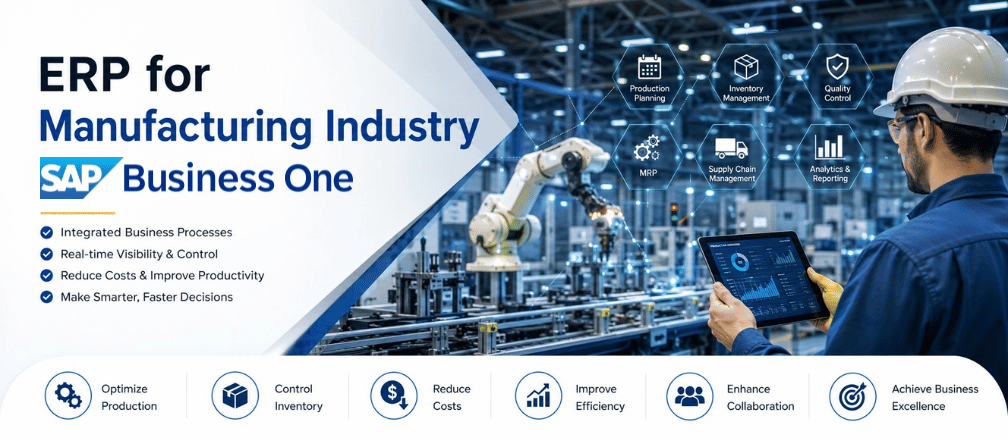
Manufacturing businesses today face increasing pressure to improve productivity, reduce operational costs, maintain quality, and meet customer demands. Managing production, inventory, procurement, finance, and sales through separate systems often leads to inefficiencies and errors.
An ERP (Enterprise Resource Planning) system for the manufacturing industry integrates all business processes into a single platform, enabling manufacturers to gain real-time visibility, automate operations, and make data-driven decisions.
In this blog, we’ll explore how ERP benefits manufacturing companies, key features to look for, and why SAP Business One is a preferred ERP solution for small and mid-sized manufacturers.
What is ERP for the Manufacturing Industry?
ERP for manufacturing is a business management software designed to integrate and automate core manufacturing operations, including:
- Production Planning
- Material Requirements Planning (MRP)
- Inventory Management
- Purchasing
- Sales & Distribution
- Finance & Accounting
- Quality Control
- Warehouse Management
- Batch & Serial Number Tracking
- Customer Relationship Management (CRM)
Instead of managing multiple disconnected applications or spreadsheets, manufacturers can manage their entire business through one centralized system.
Why Manufacturing Companies Need an ERP System
As manufacturing businesses grow, operational complexity increases. Common challenges include:
- Poor inventory visibility
- Production delays
- Excess or shortage of raw materials
- Manual data entry
- Inaccurate demand forecasting
- Difficulty tracking production costs
- Lack of real-time reports
- Compliance and traceability issues
An ERP system helps overcome these challenges by connecting every department and providing accurate, real-time business information.
Key Benefits of ERP for Manufacturing Industry
1. Centralized Business Management
ERP connects every department into one integrated platform, eliminating duplicate data entry and improving collaboration.
2. Better Production Planning
Advanced planning tools help manufacturers:
- Plan production efficiently
- Allocate resources
- Reduce machine downtime
- Meet delivery schedules
3. Material Requirements Planning (MRP)
MRP automatically calculates:
- Raw material requirements
- Purchase recommendations
- Production schedules
- Stock replenishment
This minimizes inventory shortages and excess stock.
4. Inventory Optimization
ERP provides real-time inventory visibility across warehouses.
Benefits include:
- Reduced carrying costs
- Improved stock accuracy
- Faster inventory movement
- Better warehouse utilization
5. Batch & Serial Number Traceability
Manufacturers can easily track:
- Raw materials
- Work-in-progress
- Finished goods
- Product history
This is especially useful for industries like:
- Food & Beverage
- Pharmaceuticals
- Chemicals
- Medical Devices
6. Quality Management
ERP helps monitor quality at every stage of production by:
- Recording inspections
- Managing quality checkpoints
- Tracking non-conformities
- Maintaining compliance records
7. Cost Control
ERP provides accurate costing by tracking:
- Material costs
- Labor costs
- Machine costs
- Overheads
This helps improve profitability.
8. Real-Time Reporting & Analytics
Manufacturers gain access to dashboards and reports for:
- Production performance
- Inventory status
- Sales
- Purchasing
- Financial reports
- Profitability analysis
Decision-makers can access accurate information instantly.
Essential ERP Features for Manufacturing Companies
A modern manufacturing ERP should include:
Production Planning
Plan production orders based on demand and available resources.
Bill of Materials (BOM)
Manage multi-level BOMs accurately.
Material Requirements Planning (MRP)
Automate procurement and production planning.
Inventory Management
Track inventory across multiple warehouses.
Procurement Management
Automate purchase requests, approvals, and supplier management.
Shop Floor Control
Monitor production activities and work orders.
Batch & Serial Number Management
Ensure complete product traceability.
Quality Management
Track inspections and quality compliance.
Financial Management
Integrate accounting with manufacturing operations.
CRM & Sales Management
Manage customer quotations, orders, and after-sales service.
Industries That Benefit from Manufacturing ERP
ERP solutions are widely used across industries such as:
- Automotive
- Auto Components
- Food & Beverage
- Pharmaceuticals
- Chemicals
- Electronics
- Electrical Equipment
- Machinery Manufacturing
- Textile & Garments
- Plastic Manufacturing
- Packaging
- Furniture
- Steel & Metal
- Engineering Products
- Consumer Goods
Why Choose SAP Business One for Manufacturing?
SAP Business One is one of the world’s leading ERP solutions designed specifically for small and medium-sized businesses.
It helps manufacturers streamline operations while supporting future business growth.
Key Manufacturing Capabilities
- Production Planning
- Bill of Materials (BOM)
- Material Requirements Planning (MRP)
- Inventory Management
- Batch & Serial Number Tracking
- Procurement
- Sales Management
- Finance & Accounting
- Production Costing
- Real-Time Dashboards
- Business Intelligence
- Mobile Access
With SAP Business One, manufacturers gain complete visibility into every stage of the production cycle, enabling faster decision-making and improved operational efficiency.
Signs Your Manufacturing Business Needs an ERP
You may need an ERP system if you experience:
- Frequent production delays
- Manual Excel-based processes
- Inventory mismatches
- Difficulty tracking raw materials
- Rising operational costs
- Lack of real-time reports
- Poor coordination between departments
- Challenges in scaling operations
If these issues sound familiar, implementing an ERP can significantly improve efficiency and business performance.
Why Choose Cogniscient Business Solutions?
Cogniscient Business Solutions is a trusted SAP Business One Gold Partner with extensive experience in ERP implementation for manufacturing businesses.
Our services include:
- ERP Consulting
- Business Process Analysis
- SAP Business One Implementation
- Customization
- Integration
- User Training
- Ongoing Support
- ERP Migration
We help manufacturers optimize operations, improve productivity, and achieve digital transformation with SAP Business One.
Conclusion
The manufacturing industry is evolving rapidly, and businesses need technology that can keep pace with changing customer expectations, market demands, and operational complexities.
An ERP solution enables manufacturers to streamline production, optimize inventory, reduce costs, improve quality, and make faster, data-driven decisions.
Whether you’re a growing manufacturer or an established enterprise looking to modernize operations, implementing the right ERP system can provide a strong foundation for long-term success.
If you’re exploring an ERP solution for your manufacturing business, SAP Business One offers the flexibility, scalability, and industry-specific capabilities needed to support sustainable growth.
Frequently asked questions
What is ERP in the manufacturing industry?
ERP is an integrated software solution that helps manufacturers manage production, inventory, purchasing, sales, finance, and other business processes through a single platform.
Which ERP is best for manufacturing companies?
The ideal ERP depends on your business size and requirements. For small and medium-sized manufacturers, SAP Business One is a popular choice due to its comprehensive manufacturing features, scalability, and ease of use.
What are the benefits of ERP for manufacturing?
Key benefits include improved production planning, inventory optimization, cost control, real-time reporting, quality management, and enhanced collaboration across departments.
Is SAP Business One suitable for manufacturing SMEs?
Yes. SAP Business One is specifically designed for small and medium-sized businesses and offers robust manufacturing capabilities such as BOM, MRP, production planning, inventory management, and batch/serial tracking.
How long does ERP implementation take?
Implementation timelines vary depending on business complexity, customization, and data migration requirements, but many manufacturing SMEs can complete implementation within a few months.