
How Much Does SAP Business One Cost for a Manufacturing Company in India?
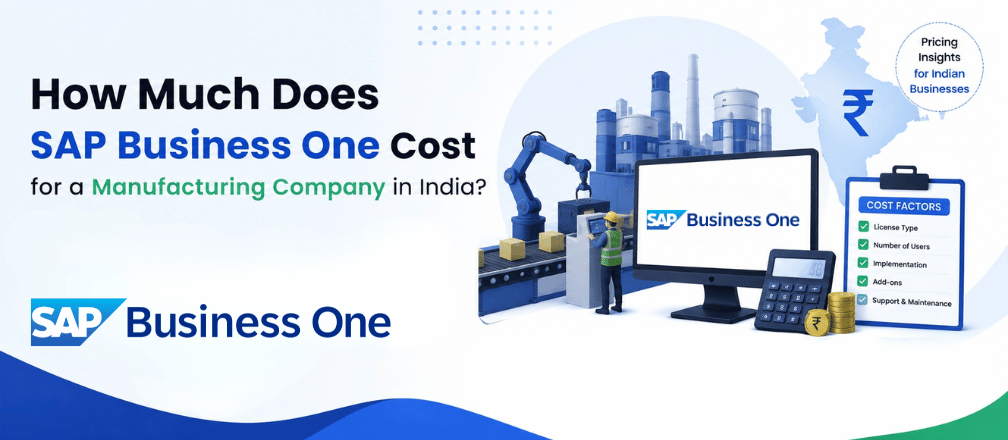
For a manufacturing company, choosing an ERP system is a significant investment. One of the first questions business owners, CFOs, IT Heads and ERP decision-makers ask is: “How much does SAP Business One cost in India?”
There is no single fixed price for SAP Business One because the total investment depends on several factors, including the number and type of users, modules required, deployment model, implementation scope, customization, integrations, manufacturing requirements and support services.
SAP Business One is designed for small and midsize businesses and provides integrated capabilities across finance, purchasing, inventory, sales, CRM, reporting and other business processes. SAP also provides manufacturing capabilities such as bills of materials, production orders, material requirements planning and production cost management.
For a manufacturing company in India, it is therefore better to look at SAP Business One cost as a combination of several components rather than expecting one standard ERP price.
What Is Included in the Cost of SAP Business One?
The overall SAP Business One investment can generally be divided into the following components:
- SAP Business One licenses or subscription
- Implementation and configuration
- Data migration
- User training
- Customization
- Third-party integrations
- Add-ons
- Cloud hosting or server infrastructure
- Support and maintenance
- Annual software maintenance, where applicable
The exact combination depends on the company’s requirements.
For example, a manufacturing company with 10 users, one location and relatively standard processes will have a different implementation scope from a company with 50 users, multiple plants, complex production processes, third-party integrations and extensive reporting requirements.
SAP Business One License Cost in India
Licensing is one of the major components of the overall SAP Business One investment.
The cost can vary depending on factors such as:
- Number of users
- User type
- Professional or limited user requirements
- Modules and functionality
- Licensing model
- Deployment model
- Contract structure
SAP Business One has different user licensing options, allowing organizations to select the appropriate user type based on the functions employees need to perform.
Therefore, instead of calculating the cost simply as “number of employees × license price,” businesses should first identify which employees actually require access and what level of functionality each user needs.
For example, a CFO, production manager, sales executive and warehouse employee may have very different ERP requirements.
SAP provides official licensing guidance and user-type information for SAP Business One.
SAP Business One Implementation Cost
Licensing is only one part of the ERP investment.
Implementation is another major component and can include:
- Business process analysis
- Requirement gathering
- System configuration
- Chart of accounts setup
- Master data configuration
- Manufacturing setup
- Inventory configuration
- User authorization setup
- Reports and dashboards
- Data migration
- Testing
- User training
- Go-live support
The implementation cost depends heavily on the complexity of the project.
A company with standard accounting, sales, purchasing and inventory processes may require less implementation effort than a manufacturing organization with multiple warehouses, production processes, subcontracting, complex BOMs, integrations and customized reports.
How Much Does SAP Business One Cost for a Manufacturing Company?
There is no universal price applicable to every manufacturing company.
As a general planning approach, an Indian manufacturing company should evaluate the complete project investment across:
License + Implementation + Infrastructure/Cloud + Customization + Integration + Support
Some publicly available 2026 market estimates place SAP Business One projects for Indian manufacturers in a broad range of ₹15 lakh to ₹90 lakh over a multi-year period, depending on licensing, implementation, customization and ongoing costs. These figures are market estimates rather than an official SAP price list, so they should not be treated as a standard quote.
Actual pricing can be significantly different from one company to another.
For this reason, businesses should request a customized quotation based on their actual requirements instead of relying on a generic online price.
SAP Business One Cost Example for a Manufacturing Company
Consider a hypothetical manufacturing company with:
- 30 SAP Business One users
- 1 manufacturing plant
- 2 warehouses
- Finance and accounting
- Sales and purchasing
- Inventory management
- Production management
- MRP
- Standard reporting
- Basic integrations
The total project investment could include:
| Cost Component | What It Covers |
|---|---|
| SAP Business One License | User licenses and applicable licensing model |
| Implementation | Configuration and deployment |
| Manufacturing Setup | BOM, production, MRP and related processes |
| Data Migration | Customers, vendors, items, opening balances and other data |
| Training | End-user and administrator training |
| Customization | Additional fields, workflows and reports |
| Integration | Connecting SAP Business One with external systems |
| Cloud/Infrastructure | Hosting or server infrastructure |
| Support | Post-go-live support and maintenance |
The final price should be calculated after understanding the company’s actual requirements.
SAP Business One Manufacturing Module Cost
Manufacturing is one of the areas where project scope can significantly affect implementation effort.
SAP Business One provides production functionality including Bills of Materials, production orders, material requirements planning and production cost management. Production orders can be created manually or generated through planning recommendations, and production processes can track material consumption and additional costs.
For a manufacturing company, the ERP implementation may therefore need to cover:
- Bill of Materials (BOM)
- Production orders
- Material Requirements Planning (MRP)
- Production planning
- Material consumption
- Finished goods
- Work-in-progress
- Production costing
- Resource management
- Inventory management
- Batch and serial number management
- Purchase planning
- Warehouse management
The more complex the manufacturing process, the more important it becomes to conduct a detailed requirement analysis before estimating the implementation cost.
What Factors Affect SAP Business One Cost in India?
Number of Users
The number of users directly affects licensing requirements.
However, user count alone does not determine the complete project cost. Different users may require different levels of access.
User Type
SAP Business One supports different user types. A company should map employees to their actual job responsibilities before selecting licenses.
This can help avoid paying for functionality that users do not need.
Manufacturing Complexity
A simple assembly operation and a complex multi-stage manufacturing process will have different ERP requirements.
Factors such as BOM complexity, production planning, subcontracting, resource management and costing can affect implementation scope.
Number of Locations
Companies operating multiple plants, warehouses or branches may require additional configuration, processes, reporting and integration.
Customization
Standard SAP Business One functionality may cover many business processes, but companies sometimes require customized:
- Reports
- Dashboards
- Workflows
- Approval processes
- Fields
- Forms
- Business logic
- Industry-specific processes
Customization can increase both implementation cost and future maintenance requirements.
Third-Party Integrations
Manufacturing companies often use additional systems such as:
- CRM
- E-commerce
- Payroll/HRMS
- Barcode systems
- Weighing systems
- Production machines
- Banking systems
- Logistics platforms
- E-invoicing systems
The number and complexity of integrations can affect project cost.
Cloud vs On-Premise
The deployment model also affects the overall investment.
With Cloud deployment, infrastructure and hosting costs are generally structured differently from an On-Premise deployment.
On-Premise may require investment in:
- Servers
- Storage
- Networking
- Backup
- Security
- IT maintenance
Cloud may reduce the need for physical infrastructure but introduce recurring hosting-related costs.
The best option depends on the company’s IT environment and business requirements.
SAP Business One Cloud vs On-Premise Cost
When comparing Cloud and On-Premise, businesses should look beyond the initial investment.
Cloud
Potential costs include:
- SAP Business One licensing/subscription
- Cloud hosting
- Implementation
- Customization
- Integration
- Support
On-Premise
Potential costs include:
- SAP Business One licenses
- Server infrastructure
- Implementation
- Database infrastructure
- Backup
- Security
- IT administration
- Customization
- Support
The right approach is to compare the Total Cost of Ownership (TCO) over several years rather than focusing only on the initial ERP price.
Is SAP Business One Worth the Investment for Manufacturing Companies?
For a growing manufacturing business, the value of an ERP system should not be measured only by the software price.
The more important question is:
What business problems will the ERP solve?
A properly implemented SAP Business One system can help bring finance, purchasing, inventory, sales, production and reporting into an integrated environment. SAP highlights integrated business management, real-time information, reporting and manufacturing capabilities as key aspects of SAP Business One.
For manufacturing companies, this can help improve visibility across:
- Raw material inventory
- Production
- Finished goods
- Purchasing
- Sales
- Warehouse operations
- Financial performance
- Customer orders
- Supplier management
- Production costs
The potential business value should therefore be evaluated alongside the implementation investment.
How to Reduce SAP Business One Implementation Cost
A lower ERP cost does not necessarily mean a better ERP project.
Instead, businesses should focus on getting the right scope from the beginning.
Define Your Requirements Clearly
Identify your current business processes and ERP requirements before implementation.
Avoid Unnecessary Customization
Use standard SAP Business One functionality wherever practical.
Customization should be considered when it provides meaningful business value.
Select the Right User Licenses
Analyze what each employee actually needs to do in the ERP before finalizing the licensing structure.
Prioritize Integrations
Not every existing system needs to be integrated immediately. Prioritize integrations based on business impact.
Plan Data Migration Carefully
Clean and organize master data before migration to reduce implementation delays and additional effort.
Invest in User Training
Well-trained users can adopt the ERP faster and reduce post-go-live issues.
Choose an Experienced Implementation Partner
The implementation partner plays an important role in requirement analysis, configuration, customization, training, testing and go-live support.
What Should You Ask Before Buying SAP Business One?
Before accepting an SAP Business One quotation, ask the implementation partner:
- What user licenses are included?
- Which modules are included?
- Is implementation included in the quoted price?
- Is data migration included?
- How many days of training are included?
- What customizations are included?
- Are integrations included?
- Is Cloud hosting included?
- What support is provided after go-live?
- What are the recurring annual costs?
- Are upgrades included?
- What additional costs could arise during implementation?
A detailed quotation should clearly separate software, implementation, customization, infrastructure, integration and support costs.
SAP Business One Cost: Why You Should Get a Customized Quote
Online SAP Business One price estimates can help you understand the broad investment level, but they cannot accurately determine the cost of your specific project.
A manufacturing company with 20 users and one plant may have completely different requirements from a company with 50 users, multiple plants, complex production processes and several integrations.
That’s why the best way to estimate SAP Business One cost is to start with a business requirement assessment.
The assessment should consider:
- Number of users
- Current ERP
- Business turnover
- Manufacturing processes
- Number of plants
- Warehouses
- Modules required
- Current IT infrastructure
- Integrations
- Customization requirements
- Cloud or On-Premise preference
- Future growth plans
Once these requirements are understood, an implementation partner can prepare a more meaningful estimate.
Why Choose Cogniscient Business Solutions for SAP Business One?
Cogniscient Business Solutions helps businesses implement SAP Business One according to their operational and industry-specific requirements.
For manufacturing organizations, the implementation approach can cover areas such as:
- Finance and accounting
- Sales
- Purchasing
- Inventory
- Production
- MRP
- Warehouse management
- Business reporting
- Integrations
- Customization
- Cloud deployment
- On-Premise deployment
With the right implementation approach, SAP Business One can provide manufacturing companies with a centralized ERP platform for managing their core business processes.
Get a Customized SAP Business One Cost Estimate
Wondering how much SAP Business One will cost for your manufacturing company in India?
Don’t rely on a generic ERP price.
Get a customized estimate based on your number of users, manufacturing processes, plants, warehouses, modules, integrations, customization requirements and preferred deployment model.
Talk to Cogniscient Business Solutions‘ SAP Business One experts today to understand your expected investment, implementation roadmap and the right ERP configuration for your business.
Frequently asked questions
How much does SAP Business One cost in India?
SAP Business One does not have one fixed price for every company. The total investment depends on users, licensing model, implementation, customization, integrations, infrastructure and support requirements. Public market estimates for Indian manufacturing projects vary widely, so a customized quotation is recommended.
Is SAP Business One suitable for manufacturing companies?
Yes. SAP Business One includes manufacturing-related capabilities such as BOM management, production orders, MRP and production cost management.
Does SAP Business One support Cloud and On-Premise deployment?
SAP Business One is available through both on-premise and on-demand deployment options.
What affects SAP Business One implementation cost?
The major factors include user count, business processes, manufacturing complexity, number of locations, customization, data migration, integrations, reporting, infrastructure and training.
Is SAP Business One a one-time investment?
The cost structure depends on the licensing and deployment model. Businesses should consider not only the initial license and implementation investment but also recurring costs such as maintenance, hosting, support and future enhancements.
How can I get an accurate SAP Business One quotation?
The most accurate approach is to discuss your business requirements with an SAP Business One implementation partner. A customized proposal can then be prepared based on your users, modules, manufacturing processes, locations and integrations.