ERP Software for Chemical Manufacturing Companies: Features & Benefits
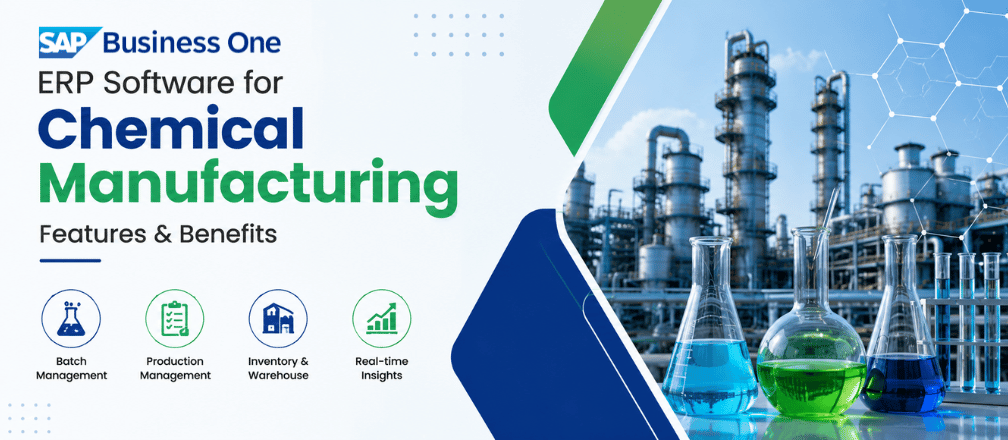
Chemical manufacturing is one of the most process-intensive industries, with businesses managing raw materials, formulations, production processes, inventory, quality requirements, batch tracking, procurement, sales and financial operations simultaneously.
As a chemical manufacturing company grows, managing these processes through spreadsheets, disconnected software or basic accounting systems can create operational challenges. Maintaining accurate inventory, tracking batches, monitoring production costs and ensuring timely availability of raw materials can become increasingly difficult.
This is where ERP software for chemical manufacturing companies can make a significant difference.
A manufacturing ERP brings key business processes together on a centralized platform, helping chemical companies improve visibility, streamline operations and make better business decisions.
For growing chemical manufacturers in India, SAP Business One can provide an integrated ERP platform covering finance, purchasing, inventory, sales, production and reporting.
Why Do Chemical Manufacturing Companies Need ERP Software?
Chemical manufacturing involves complex processes that require accurate information at every stage of the business.
A typical chemical manufacturer may need to manage:
- Raw material procurement
- Multiple suppliers
- Formulations and recipes
- Batch production
- Production planning
- Quality checks
- Inventory across warehouses
- Finished goods
- Work-in-progress
- Sales orders
- Customer requirements
- Production costs
- Financial accounting
- Regulatory and compliance-related information
When these processes are managed through different systems, information can become fragmented between departments.
Common challenges include:
- Difficulty tracking raw materials
- Inaccurate or delayed inventory information
- Manual production planning
- Difficulty tracking batches
- Limited visibility into production costs
- Excess or shortage of inventory
- Delayed financial reporting
- Manual data entry
- Difficulty managing multiple warehouses
- Lack of real-time business visibility
An integrated ERP system can connect these processes and provide management with a centralized view of operations.
What Is ERP Software for Chemical Manufacturing?
ERP software for chemical manufacturing is designed to help businesses manage their core manufacturing and business processes through an integrated system.
Instead of using separate applications for finance, purchasing, inventory, production and sales, an ERP can connect these functions.
For example, when a customer places an order, the information can be linked with inventory availability, production requirements, procurement and financial processes.
This integrated approach can help chemical manufacturers improve coordination between departments and reduce dependence on manually consolidated information.
Key Features of ERP Software for Chemical Manufacturing Companies
The right ERP for a chemical manufacturing company should address both manufacturing requirements and broader business operations.
Batch Management
Batch tracking is particularly important for chemical manufacturers.
ERP software can help businesses maintain information related to production batches, inventory movements and finished products.
This can improve traceability and help businesses identify where materials came from and where finished products were delivered.
Bill of Materials and Formulation Management
Chemical manufacturing often involves specific formulations, recipes or material combinations.
An ERP can help maintain structured Bills of Materials and production information so that production teams have better visibility into required materials and quantities.
Production Management
ERP software can help manufacturers manage production orders and monitor production activities.
Production management can cover:
- Production planning
- Production orders
- Material consumption
- Finished goods
- Work-in-progress
- Production costs
- Resource requirements
Material Requirements Planning
Material Requirements Planning (MRP) helps businesses determine material requirements based on factors such as demand, inventory and production plans.
For chemical manufacturers, effective material planning can help reduce the risk of raw material shortages while avoiding unnecessary inventory accumulation.
Inventory Management
Inventory is a critical part of chemical manufacturing.
Businesses may need to manage:
- Raw materials
- Chemicals
- Packaging materials
- Work-in-progress
- Finished products
- Batch-wise inventory
- Multiple warehouses
An ERP can provide better visibility into inventory levels, stock movements and material availability.
Warehouse Management
Chemical companies often operate multiple storage locations or warehouses.
ERP software can help manage:
- Goods receipts
- Goods issues
- Stock transfers
- Inventory movements
- Warehouse-wise stock
- Batch-wise stock
This can help warehouse and production teams work with more accurate information.
Procurement Management
Chemical manufacturing depends heavily on the timely availability of raw materials.
ERP software can connect procurement with inventory and production requirements.
Procurement teams can manage:
- Purchase requisitions
- Purchase orders
- Supplier information
- Goods receipts
- Purchase history
- Material requirements
This can help businesses improve purchasing visibility and planning.
Sales and Order Management
ERP software can connect sales orders with inventory, production and delivery processes.
Sales teams can get better visibility into product availability, while production and warehouse teams can understand upcoming demand.
Financial Management
A manufacturing ERP should connect operational transactions with finance.
Chemical companies can manage:
- Accounts receivable
- Accounts payable
- General ledger
- Cash flow
- Purchase transactions
- Sales transactions
- Production-related costs
- Financial reporting
This gives finance teams greater visibility into the financial impact of business operations.
Production Costing
Understanding the cost of manufacturing is essential for chemical businesses.
ERP software can help organizations monitor costs associated with materials, production and other manufacturing activities.
Better cost visibility can support pricing decisions, profitability analysis and management reporting.
Reporting and Analytics
Management needs timely information to make informed decisions.
ERP reporting can provide visibility into:
- Sales
- Inventory
- Purchasing
- Production
- Financial performance
- Customer orders
- Supplier performance
- Product performance
Instead of manually consolidating information from multiple systems, management can work with centralized business data.
Benefits of ERP Software for Chemical Manufacturing Companies
Implementing the right ERP can provide several operational and strategic benefits.
Better Inventory Visibility
Chemical manufacturers can gain improved visibility into raw materials, finished goods and stock movements across warehouses.
This can help reduce inventory-related errors and support better purchasing and production decisions.
Improved Production Planning
Production teams can use centralized information about demand, inventory and material requirements to plan production more effectively.
Better Batch Traceability
Centralized batch information can help businesses track materials and finished products through different stages of the supply chain.
Reduced Manual Work
Automating repetitive processes can reduce manual data entry and the need to maintain information across multiple spreadsheets.
Improved Departmental Coordination
Finance, sales, purchasing, production and warehouse teams can work with information from the same ERP system.
Better Financial Visibility
By connecting operational transactions with accounting, businesses can get a clearer picture of revenues, costs and profitability.
Faster Decision-Making
Management can access relevant business information more quickly instead of waiting for manually prepared reports.
Support for Business Growth
As the business expands, an ERP can support additional users, warehouses, locations and business processes based on the organization’s requirements.
SAP Business One for Chemical Manufacturing Companies
SAP Business One is an integrated ERP solution designed for small and midsize businesses.
For chemical manufacturers, SAP Business One can bring together important business functions such as:
- Financial management
- Sales
- Purchasing
- Inventory
- Production
- MRP
- Warehouse management
- Customer relationship management
- Reporting and analytics
Its integrated approach can help chemical manufacturers connect operational processes with financial management.
For example, purchasing requirements can be linked with inventory and production planning, while sales transactions can flow into inventory and financial processes.
This can provide management with better visibility across the business.
How SAP Business One Can Help Chemical Manufacturers
Chemical manufacturers can use SAP Business One to manage several important areas from a centralized ERP environment.
Raw Material Management
Monitor raw material availability and purchasing requirements to support uninterrupted production.
Production Planning
Manage production orders and material requirements while improving visibility into manufacturing activities.
Batch and Inventory Tracking
Maintain better visibility into inventory and batch-related information throughout the business process.
Warehouse Management
Manage stock across multiple warehouses and monitor inventory movements.
Procurement
Connect purchasing activities with material requirements and inventory information.
Financial Management
Integrate accounting with sales, purchasing, inventory and other operational transactions.
Management Reporting
Provide management with centralized information for monitoring business performance and making informed decisions.
Cogniscient Business Solutions’ Experience in the Chemical Industry
Choosing an ERP implementation partner with relevant industry experience can be an important part of a successful ERP project.
Cogniscient Business Solutions has experience serving businesses in the chemical and related industries, including:
- Algol Chemicals India
- KPL International
- Versatile Bond
- Jogniya Explosives Pvt. Ltd.
- Neha Herbal
- Saan Global Limited
- Zahonero India Pvt. Ltd.
This experience gives Cogniscient an understanding of the operational requirements that chemical and process-oriented businesses can face.
Every organization has different processes, so an ERP implementation should be planned around the company’s actual requirements rather than applying a standard configuration to every business.
What Should Chemical Companies Consider Before Selecting an ERP?
Before selecting an ERP software for chemical manufacturing, companies should evaluate the following:
Manufacturing Requirements
Does the ERP support your production processes, formulations, BOMs, production orders and planning requirements?
Batch and Traceability Requirements
Can the system provide the level of batch tracking and traceability required by your business?
Inventory Requirements
Can it manage raw materials, finished goods, multiple warehouses and inventory movements effectively?
Integration Requirements
Can the ERP integrate with your existing systems, applications and business tools?
Scalability
Can the solution support your future users, warehouses, locations and business growth?
Customization
Can the ERP accommodate specific business processes without excessive customization?
Implementation Partner
Does the implementation partner understand your industry and have experience implementing ERP for manufacturing businesses?
Total Cost of Ownership
Look beyond the initial license cost and consider implementation, customization, integration, infrastructure, support and future requirements.
When Should a Chemical Manufacturing Company Implement an ERP?
Your company may be ready for an ERP if you are experiencing challenges such as:
- Managing operations through Excel
- Using separate software for different departments
- Difficulty tracking inventory
- Limited batch visibility
- Manual production planning
- Frequent inventory discrepancies
- Difficulty calculating production costs
- Delayed management reports
- Multiple warehouses becoming difficult to manage
- Increasing manual work as the business grows
- Lack of real-time business information
These challenges can indicate that the business has outgrown its existing systems and may benefit from an integrated ERP platform.
Cloud vs On-Premise ERP for Chemical Manufacturing
Chemical manufacturers should also consider how they want to deploy their ERP.
Cloud ERP
Cloud deployment can be suitable for businesses that want:
- Remote accessibility
- Reduced infrastructure management
- Flexible scalability
- Easier access across multiple locations
- Lower dependence on physical servers
On-Premise ERP
On-Premise deployment can be suitable for companies that:
- Already have established IT infrastructure
- Have dedicated IT resources
- Require greater control over their infrastructure
- Have specific infrastructure requirements
The right deployment model depends on the company’s IT infrastructure, security requirements, budget, accessibility needs and long-term business plans.
How Much Does ERP Software Cost for a Chemical Manufacturing Company?
There is no standard ERP price applicable to every chemical manufacturer.
The total investment can depend on:
- Number of users
- User licenses
- Modules required
- Implementation scope
- Manufacturing complexity
- Number of warehouses
- Number of locations
- Customization
- Data migration
- Integrations
- Cloud hosting or infrastructure
- Training
- Support and maintenance
A small chemical manufacturer with a single location will have very different requirements from a larger organization operating multiple warehouses, production facilities and complex processes.
Therefore, companies should evaluate the Total Cost of Ownership (TCO) and request a customized proposal based on their actual requirements.
How to Select the Right ERP for Your Chemical Manufacturing Business
Before making a final decision, create a detailed list of your current and future requirements.
Evaluate the ERP based on:
- Manufacturing functionality
- Batch management
- Inventory management
- Production planning
- MRP
- Procurement
- Warehouse management
- Financial management
- Reporting and analytics
- Integration capabilities
- Scalability
- Implementation partner experience
- Cloud and On-Premise options
- Total Cost of Ownership
It is also important to involve key stakeholders such as the CEO, CFO, CIO, CTO, IT Head, production team, finance team and operations team during the ERP evaluation process.
Why Choose Cogniscient Business Solutions for Chemical Industry ERP?
Implementing an ERP successfully requires more than selecting the right software.
The implementation partner needs to understand your business processes, identify gaps, configure the solution correctly and ensure that employees can effectively use the system.
Cogniscient Business Solutions provides SAP Business One consulting, implementation, customization, integration, Cloud and On-Premise deployment and post-implementation support.
Our experience with businesses in the chemical and related industries helps us understand the operational challenges that manufacturers can face across procurement, inventory, production, sales and finance.
With the right ERP strategy, chemical manufacturers can move from disconnected systems and manual processes toward a more integrated and data-driven way of managing their business.
Transform Your Chemical Manufacturing Operations with SAP Business One
Managing a growing chemical manufacturing business with spreadsheets and disconnected systems can make it difficult to maintain visibility across production, inventory, procurement, sales and finance.
SAP Business One can help bring these processes together on a centralized ERP platform.
If you are evaluating ERP software for your chemical manufacturing company, Cogniscient Business Solutions can help you understand your requirements, evaluate the right deployment approach and determine how SAP Business One can fit into your business processes.
Get a Free SAP Business One Consultation
Speak with our SAP Business One experts to discuss your chemical manufacturing processes, ERP requirements, number of users, locations and business goals.
Book a Free SAP Business One Demo and discover how an integrated ERP can help you improve visibility, streamline operations and support your next stage of growth.