
SAP Business One ERP for Battery Manufacturers: Features, Benefits & Industry Solutions
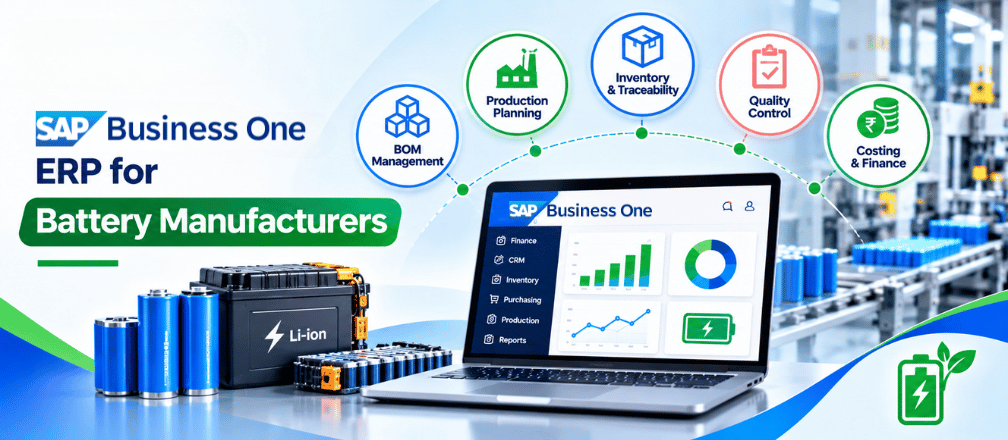
The battery manufacturing industry is evolving rapidly with the growth of electric vehicles (EVs), renewable energy storage, industrial equipment and consumer electronics. As demand for batteries increases, manufacturers must manage complex production processes, raw material procurement, inventory, quality control, batch traceability and customer deliveries.
Managing these operations through spreadsheets or disconnected software can create challenges such as material shortages, production delays, inaccurate costing, quality issues and limited visibility into inventory.
This is where SAP Business One ERP for battery manufacturers can make a difference. An integrated ERP system helps connect production, purchasing, inventory, finance, sales and quality-related processes, enabling businesses to manage operations more efficiently.
SAP Business One, implemented and configured to suit manufacturing requirements, can help battery manufacturers improve operational visibility, manage material requirements and build better control over their supply chain.
In this blog, we explore how SAP Business One supports battery manufacturing companies, its key features, benefits and how Cogniscient Business Solutions can help.
Why Do Battery Manufacturers Need ERP Software?
Battery manufacturing involves multiple raw materials, components and production stages. Depending on the battery type, the process may include material preparation, component manufacturing, cell assembly, formation, testing, pack assembly and final inspection.
Each stage requires coordination between production, procurement, inventory, quality and finance teams.
Some common challenges faced by battery manufacturers include:
1. Complex raw material management
Battery manufacturers work with materials and components such as cells, electrodes, separators, electrolytes, casings, connectors, battery management systems (BMS) and packaging materials. Managing availability and consumption accurately is essential.
2. Batch and serial number traceability
Manufacturers need to identify the materials and components used in production and track finished battery products. Inadequate traceability can make it difficult to investigate quality issues or manage product recalls.
3. Production planning challenges
Different battery models may have different BOMs, component requirements and production processes. Manual planning can lead to material shortages, excess stock and delays.
4. Quality control requirements
Battery performance, safety and reliability depend on quality checks at different manufacturing stages. Businesses need organised inspection records and visibility into rejected or reworked products.
5. Difficulty tracking manufacturing costs
Battery production costs can involve raw materials, bought-out components, labour, utilities, production overheads and other expenses. Without integrated information, calculating product-level costs can be challenging.
6. Supplier and procurement coordination
Manufacturers often depend on multiple suppliers for raw materials, electronic components and packaging. Delays in procurement can affect production schedules and delivery commitments.
7. Limited operational visibility
When departments use separate systems, management may not have a consolidated view of production progress, stock availability, purchasing commitments and financial performance.
An ERP system helps bring these processes together and gives teams access to more consistent business information.
How SAP Business One Supports Battery Manufacturing Companies
SAP Business One is an integrated ERP solution designed for small and mid-sized businesses. It connects financial management, purchasing, inventory, sales, production and reporting in one system.
For battery manufacturers, SAP Business One can support key manufacturing workflows through its core functionality and, where needed, industry-specific add-ons and integrations.
Key Features of SAP Business One ERP for Battery Manufacturers
1. Bill of Materials (BOM) Management
A battery product may consist of several components, subassemblies and raw materials. Different battery models and capacities may require different product structures.
SAP Business One supports Bill of Materials management to define the components and quantities required to manufacture a product.
Key capabilities include:
- Create and maintain product BOMs
- Define raw materials and component quantities
- Manage subassemblies and finished products
- Support production order creation
- Track material consumption
- Maintain product structure information
- Support material planning based on production requirements
Accurate BOM information helps manufacturers plan materials and maintain consistency across production activities.
2. Production Planning and Management
Battery manufacturers need to coordinate production stages, material availability and manufacturing schedules.
SAP Business One supports production orders and related inventory transactions, helping businesses manage production activities.
Manufacturers can use the system to:
- Create and manage production orders
- Define planned material requirements
- Issue components for production
- Record material consumption
- Receive finished goods into inventory
- Monitor production-related transactions
- Review production order status
For businesses that need detailed stage-wise production tracking, shop-floor data collection or advanced scheduling, additional configuration, add-ons or integrations may be required.
3. Material Requirements Planning (MRP)
Material Requirements Planning helps manufacturers identify what materials are required, how much is needed and when procurement or production should take place.
For battery manufacturers, MRP can help plan requirements for cells, electrodes, electronic components, casings, connectors, packaging materials and other production inputs.
MRP planning can consider:
- Existing inventory
- Open purchase orders
- Sales demand
- Production orders
- BOM requirements
- Minimum inventory levels
- Planned lead times
This helps purchasing and production teams coordinate material availability and reduce the risk of production interruptions.
4. Batch and Serial Number Traceability
Traceability is particularly important in battery manufacturing because businesses may need to identify the source and movement of materials and finished products.
SAP Business One provides batch and serial number management capabilities that can help businesses track relevant inventory items.
Depending on the configured process, manufacturers can use these capabilities to:
- Track selected raw materials by batch
- Assign serial numbers to finished battery products
- Record goods receipts and inventory movements
- Track component and finished product information
- Support warranty and service processes
- Retrieve relevant product movement records
For advanced end-to-end genealogy—linking every raw material lot, production operation, test result and finished battery serial number—manufacturers may require additional traceability solutions or integrations.
5. Inventory and Warehouse Management
Battery manufacturers need accurate control over raw materials, components, work-in-progress, finished batteries, spare parts and packaging materials.
SAP Business One inventory management helps businesses monitor stock movements and warehouse information.
Important capabilities include:
- Multiple warehouse management
- Goods receipt and goods issue
- Inventory transfers
- Stock availability monitoring
- Batch and serial number tracking
- Inventory valuation
- Reorder level management
- Inventory movement reporting
Better inventory visibility helps companies make informed purchasing decisions and manage material availability across locations.
6. Quality Control and Inspection Management
Quality control plays a major role in battery manufacturing. Material quality and production consistency can affect battery performance, reliability and safety.
ERP-supported quality processes can help businesses maintain organised inspection records and coordinate quality-related activities.
Examples of quality checkpoints include:
- Incoming raw material inspection
- Component inspection
- In-process production checks
- Cell testing and validation
- Battery pack inspection
- Finished goods inspection
- Rejection and rework recording
SAP Business One can be configured and extended to support quality-related workflows. Manufacturers requiring specialised test data capture, laboratory management, automated testing equipment integration or advanced quality management should assess the need for dedicated add-ons or external systems.
7. Purchasing and Supplier Management
Battery manufacturing companies rely on a network of suppliers for raw materials, cells, electronic components, casings, connectors and packaging.
SAP Business One purchasing functionality helps manage procurement activities and supplier transactions.
Key features include:
- Supplier master data
- Purchase quotations
- Purchase requests and purchase orders
- Goods receipt processing
- Supplier invoice management
- Purchase price information
- Outstanding purchase order tracking
- Supplier payment visibility
When purchasing is connected with inventory and MRP, procurement teams can make decisions based on material requirements and stock availability.
8. Financial Management and Manufacturing Costing
Battery manufacturers need to monitor material costs, production expenses, operating costs and product profitability.
SAP Business One connects financial information with purchasing, inventory, sales and production-related transactions.
Businesses can manage:
- General ledger and accounting
- Accounts payable and receivable
- Cash flow
- Purchase and inventory costs
- Inventory valuation
- Production-related cost information
- Sales revenue and expenses
- Financial statements
- Profitability reports
A suitable costing configuration helps management understand product costs and identify opportunities to control expenses.
9. Sales and Customer Management
Battery manufacturers may supply products to EV companies, distributors, OEMs, industrial customers and energy storage businesses.
SAP Business One helps manage customer information and sales activities.
Features include:
- Customer master data
- Lead and opportunity management
- Sales quotations
- Sales orders
- Delivery documentation
- Customer communication history
- Outstanding receivables
- Sales analysis
With sales and inventory information connected, teams can review product availability and coordinate customer commitments more effectively.
10. Service, Warranty and After-Sales Management
Battery products may require warranty support, replacement coordination and service tracking.
SAP Business One includes service management capabilities that can help businesses organise service calls, customer equipment information and service-related activities.
Depending on the business process, manufacturers can manage:
- Customer service records
- Product serial number information
- Warranty-related details
- Service calls
- Repair and replacement activities
- Spare parts requirements
- Customer service history
This can help improve after-sales coordination and maintain better customer records.
11. Reporting and Business Intelligence
Management needs timely information to monitor production, inventory, procurement, sales and financial performance.
SAP Business One provides reporting and analytics capabilities that help businesses review information across departments.
Useful reports may include:
- Raw material stock reports
- Batch and serial number reports
- Production order status
- Material consumption
- Purchase order status
- Inventory valuation
- Sales performance
- Customer outstanding balances
- Supplier payables
- Financial statements
These reports help management identify operational issues and make data-driven decisions.
Industry-Specific ERP Requirements for Different Battery Manufacturers
Not every battery manufacturer follows the same production process. ERP requirements can vary based on battery chemistry, product design, manufacturing model and customer segment.
Lithium-Ion Battery Manufacturers
Lithium-ion battery manufacturers may need to manage cells, electrodes, separators, electrolytes, BMS components, battery modules and finished packs.
Important ERP considerations include:
- BOM and production management
- Batch and serial number traceability
- Raw material planning
- Quality inspection records
- Inventory control
- Production costing
- Finished product tracking
Lead-Acid Battery Manufacturers
Lead-acid battery production involves materials and components such as lead, lead alloys, separators, containers, terminals and electrolytes.
Relevant ERP requirements may include:
- Raw material and component inventory
- BOM management
- Production order tracking
- Batch management
- Quality inspection records
- Scrap and material consumption tracking
- Cost and financial reporting
EV Battery Pack Manufacturers
EV battery pack manufacturers coordinate cells, modules, battery management systems, wiring, connectors, enclosures and other components.
They may require:
- Component-level inventory tracking
- Serial number management
- BOM and assembly management
- Production stage tracking
- Quality and testing records
- Warranty information
- Vendor coordination
Industrial and Energy Storage Battery Manufacturers
Companies manufacturing batteries for industrial applications and energy storage systems may need to manage customised product configurations, project requirements, procurement and after-sales service.
ERP capabilities can support:
- Product and BOM management
- Project-related procurement
- Inventory and warehouse control
- Production planning
- Customer order management
- Service and warranty records
- Financial reporting
The exact ERP configuration should be based on the company’s production and traceability requirements.
Benefits of SAP Business One ERP for Battery Manufacturers
Implementing an integrated ERP system can help battery manufacturing companies improve coordination and operational visibility.
1. Better Production Planning
Production orders, BOM information and MRP help teams coordinate material requirements and production activities.
2. Improved Inventory Accuracy
Manufacturers can track raw materials, components and finished goods through integrated inventory records.
3. Stronger Traceability
Batch and serial number management can help identify and track selected materials and finished products through inventory transactions.
4. Better Procurement Control
Purchasing teams can use inventory and MRP information to plan purchases according to business requirements.
5. Improved Cost Visibility
Connecting purchasing, inventory, production and finance provides better information for analysing manufacturing expenses and profitability.
6. Reduced Manual Data Entry
An integrated ERP platform reduces the need to maintain separate records across multiple departments.
7. Improved Customer and Order Management
Sales teams can manage customer information, quotations, orders and related business transactions in one system.
8. Centralised Business Reporting
Management can access relevant financial and operational reports to monitor business performance.
Cogniscient Business Solutions: SAP Business One for Battery and EV Manufacturing
Choosing an ERP solution is only one part of digital transformation. The implementation partner must also understand the operational requirements of the manufacturing business.
Cogniscient Business Solutions (CBS) works with businesses across manufacturing and related industries to implement SAP Business One and configure ERP processes around their requirements.
Cogniscient has published its experience supporting EV manufacturers with SAP Business One, including battery-related production and traceability requirements. Its EV industry solution highlights capabilities such as stage-wise production and BOM management, battery and motor serial number traceability, plant maintenance scheduling, quality control and barcode or QR integration.
Cogniscient Customers in the EV and Battery-Related Manufacturing Ecosystem
Cogniscient has publicly featured the following EV manufacturers as customers:
1. Maa Luxmi E-Vehicles (YAKUZA)
Cogniscient’s published EV industry content describes support for inventory control, job work management and dealership operations through SAP Business One.
2. Revolt Intellicorp Pvt. Ltd.
Cogniscient identifies Revolt as an EV manufacturing customer and highlights battery traceability and integrated financial processes among the areas supported through SAP Business One.
3. Okinawa Autotech Pvt. Ltd.
Cogniscient’s published content highlights plant-to-plant coordination, centralised quality control and GST-compliant billing in its discussion of the company’s SAP Business One environment.
These references demonstrate Cogniscient’s experience in the EV manufacturing ecosystem, where battery components, battery packs, production traceability and inventory coordination are important operational considerations. They should not be interpreted as a claim that all three companies are standalone battery-cell manufacturers.
For more details, explore Cogniscient’s SAP Business One solution for EV manufacturers.
How Cogniscient Can Support Your Battery Manufacturing Business
Depending on your requirements, Cogniscient can help assess and configure SAP Business One around processes such as:
- Financial management and accounting
- Raw material and component inventory
- BOM and production order management
- MRP and procurement planning
- Batch and serial number tracking
- Stage-wise production workflows
- Quality control processes
- Barcode and QR code integration
- Plant maintenance requirements
- Sales and customer management
- Business reporting and analytics
The final solution scope depends on the battery manufacturing process, required traceability level, production complexity and any additional systems that need to be integrated.
How to Choose the Right ERP Software for a Battery Manufacturing Company
Before selecting ERP software, battery manufacturers should evaluate their operational requirements carefully.
1. Understand your battery manufacturing process
Identify your production stages, product types, assembly processes and material requirements.
2. Evaluate BOM and production capabilities
Check whether the ERP can support your product structures, production orders, component consumption and finished goods reporting.
3. Review batch and serial number traceability
Determine whether you need raw material batch tracking, finished battery serial numbers or complete production genealogy.
4. Assess quality management requirements
Identify the inspections, test results, compliance records and quality workflows that need to be maintained.
5. Check inventory and warehouse management
Ensure that the system can manage multiple warehouses, components, raw materials, work in progress and finished products.
6. Evaluate costing and financial reporting
Check whether the ERP can provide the information needed to analyse material costs, production expenses and product profitability.
7. Consider integrations and add-ons
Identify requirements for barcode scanners, QR codes, testing equipment, shop-floor systems, maintenance applications and other third-party tools.
8. Choose an experienced implementation partner
Select a partner that understands manufacturing operations, ERP configuration, data migration, user training and post-implementation support.
Is SAP Business One Suitable for Battery Manufacturers?
SAP Business One can be a suitable ERP option for small and mid-sized battery manufacturers that want to integrate finance, purchasing, inventory, sales and core production processes.
It can be particularly relevant for businesses looking to:
- Manage BOMs and production orders
- Improve raw material planning
- Track inventory across warehouses
- Use batch and serial number management
- Connect purchasing with production requirements
- Monitor financial and operational performance
- Improve coordination between departments
However, battery manufacturing can involve specialised requirements such as detailed process manufacturing, advanced quality testing, production genealogy, automated shop-floor data capture and regulatory documentation.
Businesses should evaluate these requirements during the ERP assessment to determine whether SAP Business One’s standard capabilities, configuration and suitable add-ons or integrations will meet their needs.
Conclusion
Battery manufacturers operate in a demanding environment where production planning, material availability, quality, traceability and cost control are essential.
An integrated ERP solution can help bring these business processes together and provide better visibility across manufacturing operations.
SAP Business One offers capabilities for financial management, inventory, purchasing, production, MRP, sales and reporting. With suitable configuration and additional solutions where required, it can support the operational needs of battery and EV-related manufacturers.
Cogniscient Business Solutions brings experience in SAP Business One implementation for manufacturing and the EV ecosystem, including publicly featured customers such as YAKUZA, Revolt and Okinawa.