SAP Business One Modules List & Features: Finance, CRM, Inventory, Purchasing & Production
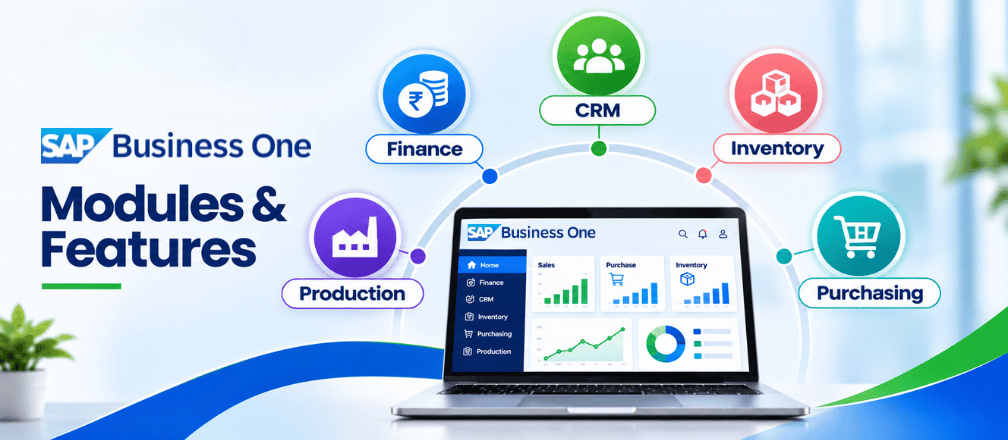
Managing a growing business involves multiple departments, processes and operations. From handling financial transactions and customer relationships to managing inventory, purchasing raw materials and monitoring production, every department plays an important role in business success.
However, when these departments operate through disconnected software, spreadsheets or manual processes, maintaining accurate information and coordinating activities becomes challenging.
This is where SAP Business One ERP makes a difference.
SAP Business One is an integrated ERP solution designed for small and midsize businesses. It connects different business functions through a centralized platform, helping organizations streamline operations, improve visibility and make informed business decisions.
Whether you operate a manufacturing company, trading business, distribution company or service organization, SAP Business One offers multiple modules to manage your business processes.
In this guide, we will explore the major SAP Business One modules, their features and benefits, and how they help businesses improve operational efficiency.
What Are SAP Business One Modules?
SAP Business One modules are different functional areas of the ERP system designed to manage specific business activities.
Each module focuses on a particular department or business process, but the modules are integrated with one another.
For example, when a sales order is created, it can affect inventory availability, delivery planning and financial transactions.
Similarly, when a purchase order is processed, the information can flow into inventory management and accounts payable.
This integration reduces the need for duplicate data entry and provides businesses with a centralized view of their operations.
Complete SAP Business One Modules List
SAP Business One includes several functional modules that help businesses manage their day-to-day operations.
The major modules include:
- Financial Management
- Sales and Customer Relationship Management (CRM)
- Purchasing and Procurement
- Inventory and Warehouse Management
- Production and Manufacturing
- Material Requirements Planning (MRP)
- Service Management
- Project Management
- Reporting and Analytics
- Banking and Cash Management
Let’s understand each module and its important features.
1. Financial Management Module
The Financial Management module is one of the core components of SAP Business One.
It helps businesses manage accounting activities, financial transactions, cash flow and financial reporting through a centralized system.
Instead of maintaining separate financial records, companies can manage their accounting processes within the ERP.
Key Features:
- General Ledger
- Accounts Payable
- Accounts Receivable
- Journal Entries
- Chart of Accounts
- Financial Statements
- Balance Sheet
- Profit and Loss Reports
- Cash Flow Management
- Fixed Asset Management
- Budget Management
- Tax Management
- Cost Accounting
Benefits of Financial Management:
- Centralized financial information
- Better control over receivables and payables
- Improved financial reporting
- Better cash flow visibility
- Reduced manual accounting work
- Improved financial decision-making
For businesses operating in India, SAP Business One can also support relevant GST and statutory reporting requirements through appropriate localization and configuration.
2. Sales and CRM Module
The Sales and CRM module helps businesses manage customer relationships, sales activities and the complete sales process.
From identifying potential customers to managing quotations, orders and invoices, businesses can maintain customer-related information within one system.
Key Features:
- Business Partner Management
- Customer Master Data
- Lead Management
- Opportunity Management
- Sales Quotations
- Sales Orders
- Delivery Management
- A/R Invoices
- Customer Payment Tracking
- Sales Analysis
- Customer Activity Tracking
- Sales Reports
Benefits of Sales and CRM:
- Better customer relationship management
- Improved sales visibility
- Centralized customer information
- Better sales pipeline monitoring
- Faster quotation and order processing
- Improved coordination between sales and finance teams
The CRM functionality can help sales teams understand customer interactions, monitor opportunities and manage sales activities more effectively.
3. Purchasing and Procurement Module
The Purchasing module helps businesses manage their procurement activities, from purchasing requirements to supplier payments.
For manufacturing companies, procurement plays a critical role in ensuring the timely availability of raw materials.
SAP Business One connects purchasing activities with inventory and financial management.
Key Features:
- Purchase Requests
- Purchase Quotations
- Purchase Orders
- Goods Receipt POs
- A/P Invoices
- Supplier Management
- Purchase Returns
- Supplier Payments
- Purchase Reports
- Vendor Performance Analysis
Benefits of Purchasing Management:
- Better procurement planning
- Improved supplier management
- Greater visibility into purchase orders
- Reduced manual purchasing activities
- Better control over procurement expenses
- Improved coordination between purchasing and inventory teams
With purchasing and inventory connected, businesses can monitor incoming materials and make better procurement decisions.
4. Inventory and Warehouse Management Module
Inventory management is essential for manufacturing, trading and distribution businesses.
SAP Business One provides inventory management capabilities that help businesses monitor stock levels, track inventory movements and manage multiple warehouses.
Key Features:
- Item Master Data
- Inventory Tracking
- Warehouse Management
- Stock Transfers
- Goods Receipt
- Goods Issue
- Inventory Revaluation
- Inventory Counting
- Batch Management
- Serial Number Management
- Inventory Valuation
- Stock Reports
- Bin Location Management, where configured
Benefits of Inventory Management:
- Better stock visibility
- Improved inventory accuracy
- Reduced stock discrepancies
- Better warehouse coordination
- Improved material availability
- More informed purchasing decisions
- Better control over inventory valuation
For businesses operating multiple warehouses, SAP Business One helps maintain centralized inventory information and track stock movements across locations.
5. Production and Manufacturing Module
The Production module is particularly important for manufacturing companies.
It helps businesses manage production orders, Bills of Materials, material consumption and finished goods.
SAP Business One provides manufacturing functionality that connects production activities with inventory and purchasing.
Key Features:
- Bill of Materials (BOM)
- Production Orders
- Production Planning
- Material Consumption
- Component Management
- Finished Goods Receipt
- Production Order Tracking
- Material Requirements Planning
- Production Costing
- Inventory Integration
Benefits of Production Management:
- Better production planning
- Improved raw material utilization
- Better visibility into production orders
- Improved inventory coordination
- Better control over material consumption
- Improved production cost visibility
- Reduced manual production tracking
For manufacturing businesses, integrating production with purchasing and inventory can help improve coordination between departments.
6. Material Requirements Planning (MRP) Module
Material Requirements Planning is an important functionality for businesses that need to plan material availability according to demand and production requirements.
SAP Business One MRP helps businesses calculate material requirements based on factors such as demand, inventory levels, supply and planning parameters.
Key Features:
- Material Requirements Planning
- Demand Forecasting Inputs
- Inventory Availability
- Supply and Demand Analysis
- Production Recommendations
- Purchase Recommendations
- Planning Scenarios
- Material Shortage Identification
Benefits of MRP:
- Better material planning
- Reduced risk of raw material shortages
- Improved production scheduling
- Better purchasing decisions
- More effective inventory management
MRP is particularly useful for manufacturing businesses that regularly plan production based on sales demand and material availability.
7. Service Management Module
The Service Management module helps businesses manage customer service activities, service calls and equipment-related support requirements.
It is useful for organizations that provide after-sales services or maintain customer equipment.
Key Features:
- Service Call Management
- Customer Equipment Cards
- Service Contracts
- Service Tracking
- Response and Resolution Monitoring
- Service Reports
- Technician-related Information
Benefits:
- Better service request tracking
- Improved customer support
- Centralized service information
- Better visibility into service activities
- Improved after-sales service management
8. Project Management Module
Businesses handling projects, contracts or project-based activities can use SAP Business One project management functionality to monitor project-related information.
Key Features:
- Project Management
- Project Stages
- Project Activities
- Resource Planning
- Project-related Expenses
- Project Transactions
- Project Reporting
Benefits:
- Better project visibility
- Improved activity tracking
- Better expense monitoring
- Centralized project information
- Improved coordination between teams
9. Reporting and Analytics Module
Business reporting is essential for understanding operational and financial performance.
SAP Business One provides reporting and analytics capabilities that allow management to access relevant business information.
Key Features:
- Financial Reports
- Sales Reports
- Purchase Reports
- Inventory Reports
- Production Reports
- Customer Reports
- Supplier Reports
- Dashboards
- Query-Based Reports
- SAP Crystal Reports
- Analytics and Interactive Analysis, depending on the deployment and configuration
Benefits:
- Faster access to business information
- Better management visibility
- Improved decision-making
- Reduced dependence on manual reporting
- Better performance monitoring
10. Banking and Cash Management Module
Managing payments, receipts and cash flow is important for every organization.
SAP Business One provides banking and cash management functionality to help businesses monitor financial transactions.
Key Features:
- Incoming Payments
- Outgoing Payments
- Payment Means
- Bank Reconciliation
- Cash Transactions
- Payment Processing
- Cash Flow Information
- Banking Reports
Benefits:
- Better payment tracking
- Improved bank reconciliation
- Greater cash flow visibility
- Better control over financial transactions
- Reduced manual reconciliation effort
SAP Business One Modules at a Glance
| SAP Business One Module | Primary Function | Major Features |
|---|---|---|
| Financial Management | Accounting and finance | GL, AP, AR, financial reports |
| Sales and CRM | Customer and sales management | Leads, opportunities, quotations, orders |
| Purchasing | Procurement management | Purchase orders, suppliers, goods receipts |
| Inventory | Stock management | Warehouses, stock transfers, batch tracking |
| Production | Manufacturing operations | BOM, production orders, material consumption |
| MRP | Material planning | Demand, supply and purchase recommendations |
| Service Management | After-sales service | Service calls, contracts, equipment |
| Project Management | Project tracking | Activities, stages, expenses |
| Reporting and Analytics | Business intelligence | Dashboards, reports, analytics |
| Banking and Cash Management | Financial transactions | Payments, receipts, reconciliation |
How Do SAP Business One Modules Work Together?
One of the biggest advantages of SAP Business One is that its modules are integrated.
Let’s understand this with a manufacturing business example.
Imagine a manufacturing company receives an order from a customer.
Step 1: Sales
The sales team creates a quotation and converts it into a sales order.
Step 2: Inventory
The system helps check the availability of finished goods and required raw materials.
Step 3: MRP
Material requirements can be evaluated to identify additional purchasing or production requirements.
Step 4: Purchasing
The procurement team processes purchase orders for materials that need to be sourced.
Step 5: Production
Production orders are created, materials are issued and finished goods are recorded.
Step 6: Inventory and Warehouse
Finished goods are received into inventory and prepared for delivery.
Step 7: Finance
Sales invoices and related financial transactions are recorded.
Step 8: Reporting
Management can review sales, inventory, purchasing, production and financial information.
This integrated workflow helps reduce information gaps between departments and provides better visibility across the business.
Which SAP Business One Modules Does Your Business Need?
Not every business requires every module in the same way. Your ERP configuration should depend on your industry, business processes and operational requirements.
For Manufacturing Companies
Recommended functional areas include:
- Financial Management
- Purchasing
- Inventory
- Production
- MRP
- Sales
- Reporting and Analytics
For Trading and Distribution Companies
Important modules include:
- Financial Management
- Sales
- Purchasing
- Inventory
- Warehouse Management
- Banking
- Reporting and Analytics
For Chemical Manufacturing Companies
Relevant capabilities may include:
- Production
- BOM and formulation-related processes
- Batch Management
- Inventory
- Purchasing
- MRP
- Quality-related integrations or add-ons, where required
- Financial Management
For Engineering Companies
Important functional areas may include:
- Financial Management
- Sales and CRM
- Purchasing
- Inventory
- Production
- Project Management
- Reporting
The final module selection should be based on a detailed business requirement assessment.
Why Choose SAP Business One for Your Business?
SAP Business One brings multiple business functions together in one integrated ERP environment.
Its key advantages include:
- Centralized business management
- Integrated financial and operational processes
- Better inventory visibility
- Improved purchasing control
- Production planning capabilities
- Customer relationship management
- Business reporting and analytics
- Multiple deployment options
- Integration and customization possibilities
- Support for business growth
Instead of managing different departments through disconnected applications, businesses can work with a common source of operational information.
Why Choose Cogniscient Business Solutions for SAP Business One Implementation?
Selecting the right ERP is only one part of your digital transformation journey. Successful implementation also depends on the right technology partner.
Cogniscient Business Solutions helps businesses implement SAP Business One according to their industry requirements and operational processes.
Our services include:
- SAP Business One Consulting
- SAP Business One Implementation
- Business Process Analysis
- ERP Customization
- Third-Party Integrations
- Cloud Deployment
- On-Premise Deployment
- Data Migration
- User Training
- Technical Support
- Post-Implementation Services
We work with businesses across industries, helping them identify relevant ERP functionality and build an implementation approach aligned with their business goals.
Whether you are a manufacturing company, chemical business, trading organization or distribution company, our team can help you evaluate the right SAP Business One modules for your requirements.
Get the Right SAP Business One Modules for Your Business
Looking to streamline finance, CRM, purchasing, inventory and production through one integrated ERP system?
SAP Business One provides a range of modules designed to connect business operations and improve visibility across departments.
However, selecting the right modules and configuring them according to your processes is essential for getting the maximum value from your ERP investment.