
SAP Business One Cost in India: Development, Server & Annual Maintenance Explained
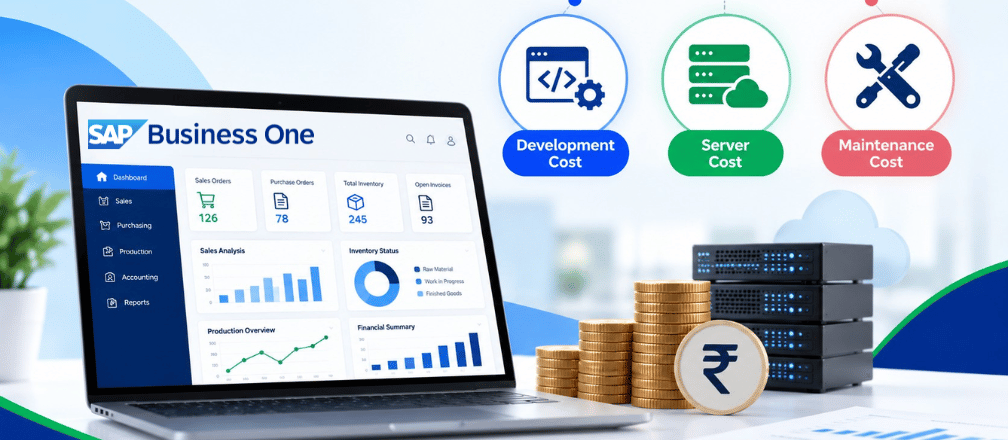
Implementing an ERP system is an important investment for any growing business. However, the software license is only one part of the total cost. Businesses must also consider implementation, customization and development, server infrastructure or cloud hosting, annual maintenance and ongoing support.
For companies planning to implement SAP Business One in India, understanding these costs in advance can help with budgeting, selecting the right deployment model and avoiding unexpected expenses.
In this guide, we explain the major cost components of SAP Business One, including development costs, server costs, annual maintenance and long-term ownership expenses.
What Are the Main Costs of SAP Business One?
The total cost of SAP Business One generally includes the following components:
- Software licenses or subscription
- Implementation and configuration
- Custom development and customization
- Server infrastructure or cloud hosting
- Annual software maintenance, where applicable
- Technical support
- Third-party integrations and add-ons
- Upgrades, training and future enhancements
The exact investment depends on the number of users, business processes, manufacturing requirements, deployment model and customization needs.
1. SAP Business One Development and Customization Cost
Every business has unique operational requirements. While SAP Business One provides standard functionality for finance, sales, purchasing, inventory and production, some companies require additional features or integrations.
Development and customization costs depend on the complexity of the requirements and the effort involved.
Common development requirements include:
- Custom reports and dashboards
- Additional forms and fields
- Approval workflows
- Industry-specific business processes
- Barcode and QR code integration
- Banking integration
- E-commerce integration
- CRM and HRMS integration
- GST-related integrations
- Manufacturing-specific add-ons
- Third-party application integration
For example, a manufacturing company may need customized production reports, while a distribution company may require additional warehouse and order-processing functionality.
What affects development cost?
The main factors include:
Complexity: A simple report generally requires less effort than a complex integration or custom application.
Business requirements: The number of workflows, screens, reports and processes affects development effort.
Integration requirements: Connecting SAP Business One with external systems can increase the project scope.
Testing: Custom development must be tested to ensure that it works correctly with the ERP environment.
Future maintenance: Customizations may require updates when business processes or software environments change.
There is no single development price applicable to every SAP Business One project. Request a requirement-based estimate that clearly identifies the development scope, deliverables and support arrangements.
2. SAP Business One Server Cost
Server infrastructure is another important consideration when implementing SAP Business One.
The cost depends on whether the business chooses an On-Premise deployment or a Cloud-hosted environment.
On-Premise Server Cost
With an On-Premise deployment, the organization operates SAP Business One within its own IT infrastructure or a designated infrastructure environment.
Potential expenses include:
- Server hardware
- Storage
- Networking
- Operating system and applicable software
- Backup infrastructure
- Security
- Power and cooling
- Hardware maintenance
- IT administration
The investment depends on the number of users, database size, transaction volume, performance requirements, backup strategy and expected business growth.
Businesses with existing infrastructure may be able to use some of their current resources, subject to technical compatibility and capacity.
SAP Business One Cloud Hosting Cost
With a Cloud deployment, the ERP infrastructure is hosted in a cloud environment.
Potential recurring costs include:
- Cloud server or virtual machine
- Storage
- Backup
- Security services
- Monitoring
- Disaster recovery
- Technical administration
- Hosting support
Cloud hosting can reduce the need to purchase and maintain physical servers. However, it introduces recurring hosting expenses, which should be considered when calculating the total cost of ownership.
Cloud vs On-Premise: Which Is More Cost-Effective?
Cloud can be attractive for companies that want to reduce infrastructure management and access the ERP across multiple locations.
On-Premise can be appropriate for businesses that already have suitable infrastructure and require greater control over their IT environment.
Neither option is automatically cheaper. The correct comparison should include infrastructure, maintenance, IT resources, hosting, backups, security and upgrades over several years.
3. SAP Business One Annual Maintenance Cost
Annual maintenance is another cost that businesses should understand before implementing an ERP.
Depending on the licensing and service arrangement, recurring expenses may include software maintenance, technical support, hosting, infrastructure maintenance and ongoing application support.
These are separate cost categories and should not be confused with one another.
Software Maintenance
For applicable licensing arrangements, software maintenance may provide access to eligible updates and related services under the applicable agreement.
The exact coverage and fees should be confirmed with the authorized SAP Business One partner.
Technical Support
Technical support may include assistance with system issues, configuration, user queries, troubleshooting and operational problems.
The cost depends on the support agreement, service hours, response-time commitments and scope of services.
Server Maintenance
Businesses operating their own infrastructure may need to budget for server monitoring, backups, security updates, hardware maintenance and technical administration.
Application Maintenance
Application maintenance can include minor configuration changes, report updates, troubleshooting and assistance with existing customizations.
Major enhancements, new integrations and substantial development may be charged separately.
What Determines Annual Maintenance Cost?
The main factors include:
- Licensing agreement
- Number of users and systems
- Cloud or On-Premise deployment
- Support coverage
- Number of customizations
- Integration complexity
- Service-level requirements
- Frequency of updates and enhancements
Before signing an agreement, ask your implementation partner to specify exactly what is included in annual maintenance and what will incur additional charges.
4. SAP Business One Implementation Cost
Implementation is separate from development and annual maintenance.
It generally covers activities such as:
- Business requirement analysis
- Process mapping
- System configuration
- Master data preparation
- Data migration
- User authorization
- Testing
- User training
- Go-live planning
- Post-go-live assistance
A company with standard accounting, inventory and sales processes may require a different implementation effort from a manufacturing company with complex production planning, multiple warehouses and several integrations.
A clear implementation proposal should define the scope, timeline, responsibilities, deliverables and any exclusions.
5. Other Costs to Consider
Apart from development, server and maintenance expenses, businesses should consider several additional costs.
Training: Employees may need training to use the system effectively.
Data Migration: Cleaning and transferring information from legacy software can require additional effort.
Add-ons: Industry-specific functionality may require third-party or partner-developed add-ons.
Integrations: Connecting banking, e-commerce, logistics, CRM or other systems can involve development and recurring service fees.
Upgrades: Major changes to the system, infrastructure or customizations may require additional investment.
Expansion: Adding users, locations, warehouses or new business processes can increase future costs.
Including these items in the budget provides a more realistic picture of the overall ERP investment.
6. How to Calculate the Total Cost of Ownership
Instead of considering only the initial implementation price, businesses should calculate the Total Cost of Ownership (TCO) over a period of three to five years.
A practical budgeting formula is:
Total ERP Cost = Licenses + Implementation + Development + Server/Hosting + Maintenance + Support + Integrations + Upgrades
For a multi-year estimate, distinguish between one-time and recurring expenses.
| Cost Component | Typical Cost Pattern |
| Software license | Depends on licensing model |
| Implementation | Generally one-time project cost |
| Development and customization | Initial and ongoing, as required |
| On-Premise server | Initial investment plus maintenance |
| Cloud hosting | Generally recurring |
| Software maintenance | Depends on licensing agreement |
| Technical support | Depends on support contract |
| Integrations and add-ons | Initial and potentially recurring |
| Training | Initial and as required |
| Future upgrades | Depends on scope and requirements |
Actual prices should be obtained from a detailed quotation. This approach avoids misleading comparisons based on incomplete pricing information.
7. How to Reduce SAP Business One Ownership Costs
Businesses can manage their ERP investment more effectively by planning the project carefully.
Define Requirements Before Implementation
Document your current processes and prioritize essential functionality.
Avoid Unnecessary Customization
Use standard SAP Business One functionality where it meets your needs. Custom development should solve a clearly identified business problem.
Choose the Right User Licenses
Map employees to their actual responsibilities and required functionality before finalizing licenses.
Compare Cloud and On-Premise Costs
Evaluate the complete multi-year cost rather than only the initial server investment or monthly hosting fee.
Plan Integrations Carefully
Prioritize integrations that deliver measurable operational value.
Maintain Clean Data
Preparing accurate master data before implementation can reduce migration problems and rework.
Clarify Support Coverage
Confirm what is included in your maintenance agreement to avoid unexpected service expenses.
8. What Should You Ask Your SAP Business One Partner?
Before approving a proposal, ask for a detailed cost breakdown.
- What is the software license cost?
- What implementation activities are included?
- Is custom development included?
- What is the estimated server or Cloud hosting cost?
- What does annual software maintenance cover?
- Is technical support included?
- Are backups and disaster recovery included?
- Are integrations and add-ons charged separately?
- What costs may arise during upgrades?
- What are the expected recurring expenses over the next three to five years?
A transparent proposal should separate one-time implementation expenses from recurring operational costs.
Why Choose Cogniscient Business Solutions for SAP Business One?
Choosing the right implementation partner is important for controlling project scope and managing long-term ERP costs.
Cogniscient Business Solutions helps businesses evaluate, implement, customize and support SAP Business One according to their business requirements.
Our services can cover implementation planning, configuration, development, integrations, deployment guidance and ongoing support.
By understanding your business processes and technical requirements before implementation, our team can help you identify the appropriate scope and prepare a more meaningful cost estimate.
Get a Customized SAP Business One Cost Estimate
Planning to implement SAP Business One but unsure about development costs, server expenses or annual maintenance?
The right budget depends on your number of users, business processes, required customizations, integrations and preferred deployment model.
Contact Cogniscient Business Solutions for a customized SAP Business One cost assessment.
Our team can help you understand the expected investment across implementation, development, infrastructure, maintenance and support, so you can make an informed ERP decision.
Frequently asked questions
How much does SAP Business One development cost?
Development cost depends on the type and complexity of custom reports, workflows, integrations and industry-specific requirements. A detailed scope assessment is necessary to prepare an accurate estimate.
What is the server cost for SAP Business One?
Server cost depends on whether the system is deployed On-Premise or in the Cloud, along with user count, performance requirements, storage, backup and security needs.
Is annual maintenance mandatory for SAP Business One?
Maintenance requirements depend on the licensing agreement and support services selected. Confirm the applicable terms and coverage with your SAP Business One partner.
Is Cloud cheaper than On-Premise?
Not in every case. Cloud generally involves recurring hosting expenses, while On-Premise can require hardware, infrastructure maintenance and IT administration. Compare the total cost over several years.
Does SAP Business One maintenance include customization?
Not necessarily. The coverage depends on the service contract. Routine support, minor changes and major development may be treated as separate services.
How can I get an accurate SAP Business One quotation?
Share your number of users, current systems, deployment preference, business requirements, integrations and support expectations with an implementation partner. A detailed proposal can then outline the initial and recurring costs.